HEALTH
Andhra Pradesh Paddy Farmers Show Silica-Induced Lung Fibrosis Missed by Chest Camps
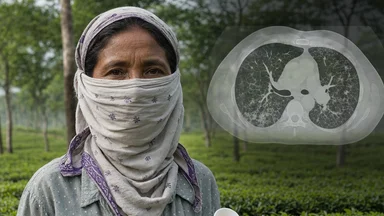
For decades, Andhra Pradesh's paddy farmers have shouldered the state's rice production, but an invisible hazard is taking a toll on their lungs. Respirable crystalline silica, released from soil and during husk processing, is causing lung fibrosis that chest camps routinely miss. A growing body of evidence suggests that primary-care doctors need new diagnostic clues to catch this occupational disease early.
Silica Dust in Paddy Fields: An Invisible Hazard
Andhra Pradesh is one of India's top rice-producing states, with millions of farmers spending long hours in paddy fields. During ploughing, transplanting, and especially during harvest, fine dust containing respirable crystalline silica gets stirred into the air. The silica particles, often smaller than 10 micrometres, can lodge deep in the lungs and trigger inflammation and scarring over years.
Unlike coal miners or construction workers, paddy farmers are not covered by occupational exposure limits for silica in India. The permissible exposure limit set by the government applies only to mining and construction, leaving agriculture unregulated. A 2019 study in the Indian Journal of Occupational and Environmental Medicine found that airborne silica levels in paddy-processing units in Andhra Pradesh exceeded recommended limits by several times.
Protective equipment is rare. Fewer than 5% of farmers wear N95 masks during harvest, according to surveys in Guntur and Krishna districts. The humid climate makes masks uncomfortable, and many farmers are unaware of the risk. As one farmer from West Godavari told a community health worker, "We thought the dust was just soil — nothing to worry about."
Over decades, cumulative exposure leads to a decline in lung function. A 2022 study from Sri Venkateswara Institute of Medical Sciences (SVIMS) in Tirupati evaluated 45 paddy farmers with respiratory symptoms. Spirometry showed restrictive patterns in more than half, and high-resolution CT scans revealed honeycombing — a hallmark of fibrosis — in many. The median exposure duration was 18 years, yet only six had been previously diagnosed with silicosis.
Chest Camps Miss Fibrosis: Why GPs Need New Clues
Government-run chest camps, designed to screen for tuberculosis, often fail to detect silica-induced fibrosis. A chest X-ray can appear normal in early stages, when fibrosis is subtle. By the time honeycombing becomes visible on X-ray, significant lung damage has already occurred.
High-resolution CT (HRCT) is far more sensitive, but it is rarely available in rural primary-care settings. Most district hospitals in Andhra Pradesh have CT scanners, but referral pathways are weak. A farmer with chronic cough might be treated for TB or COPD for months before being referred for imaging.
A study from Guntur district, published in 2021, documented 23 cases of silicosis among paddy farmers that were initially missed at chest camps. All had normal X-rays but reported progressive breathlessness. Only after HRCT scans were arranged did the honeycombing appear. The delay in diagnosis averaged 14 months, during which farmers continued working in dusty fields.
Primary-care doctors, who are often the first point of contact, rely heavily on symptoms. Cough, sputum, and breathlessness are non-specific and can be mistaken for TB — which remains common in the region. Without an occupational history, the link to silica is easily overlooked. As Dr. K. S. Reddy, a pulmonologist at a district hospital in Guntur, notes, "We need to train GPs to ask one simple question: how many years have you worked in paddy fields?"
The Diagnostic Gap: Women Farmers Most Affected
Women farmers face a disproportionately high risk. In Andhra Pradesh, women perform the bulk of manual threshing and winnowing — tasks that generate large amounts of dust. They work close to the paddy heaps, often without any mask, for hours at a time during the harvest season.
Despite this, women have less access to diagnostic tools like spirometry in rural clinics. A 2020 analysis from the National Family Health Survey found that only 12% of women in rural Andhra Pradesh had ever had a lung function test, compared to 23% of men. Cultural barriers also play a role: women may delay seeking care because they prioritise household duties over their own health.
Silica-induced fibrosis appears to progress faster in women, though the reasons are not fully understood. Some researchers point to hormonal differences or smaller airway calibre, but more studies are needed. What is clear is that women farmers are underrepresented in occupational health studies, and their symptoms are often dismissed as "weak lungs" or anaemia.
Community health workers, including ASHA workers, are often unaware of the occupational link. They are trained to screen for TB, hypertension, and diabetes, but not for chronic lung disease from agricultural dust. A pilot programme in Nellore district trained 50 ASHA workers to ask about farming history and refer farmers for spirometry; early results showed a 40% increase in detection of restrictive lung disease.
Evidence from a Tertiary Hospital Cohort
The strongest evidence for silica-induced fibrosis among paddy farmers comes from a cohort study at SVIMS, Tirupati. Researchers evaluated 45 farmers who had worked in paddy fields for at least 10 years and presented with breathlessness. Spirometry showed restrictive lung disease in 32 of them. Bronchoalveolar lavage (BAL) fluid, obtained via bronchoscopy, revealed silica particles in all 32 cases — a direct confirmation of silica exposure.
The median exposure duration was 18 years, with a range of 10 to 35 years. Only six farmers had received a prior diagnosis of silicosis, meaning nearly 80% of cases were undiagnosed. The study also found that farmers who worked in both paddy cultivation and rice milling had more severe fibrosis, suggesting that cumulative exposure from multiple sources accelerates disease.
Another finding: farmers with the highest dust exposure — those who did manual threshing without mechanisation — had lower forced vital capacity (FVC) values. The average FVC was 68% of predicted, indicating moderate to severe restriction. Despite this, many continued working because they had no alternative livelihood.
The SVIMS cohort underscores a systemic failure. Even at a tertiary hospital with advanced diagnostic capabilities, most cases were missed until they reached a specialist. As the study authors wrote, "Silicosis in agricultural workers remains underdiagnosed due to lack of awareness and absence of routine screening."
Policy Blind Spot: No Silica Standard for Agriculture
India's occupational health laws have a glaring gap: agriculture is excluded from most regulations. The Factories Act, 1948, which sets permissible exposure limits for silica, applies only to factories. Mining and construction have separate rules under the Mines Act and Building and Other Construction Workers Act, but farming — which employs nearly half the country's workforce — has no binding silica standard.
The National Programme for Prevention and Control of Silicosis (NPPCS), launched in 2016, focuses on mining and stone-crushing units. It does not cover agriculture. As of late 2024, Andhra Pradesh has not implemented any state-level surveillance for silicosis among farmers, despite evidence of the problem.
N95 respirators, which can reduce silica exposure by 95%, are not subsidised for farmers. A pack of 10 costs roughly 300–400 rupees — a significant expense for a smallholder farmer earning perhaps 5,000 rupees a month during harvest. Some NGOs distribute masks, but coverage is patchy.
The Ministry of Health and Family Welfare has acknowledged the issue in principle, but concrete action is slow. In a 2023 parliamentary reply, the ministry stated that it is "considering expanding the NPPCS to include agricultural workers," but no timeline has been set. Meanwhile, farmers continue to inhale silica year after year.
Practical Steps for Primary-Care Detection
Despite the policy gap, primary-care doctors can take practical steps to detect silica-induced fibrosis earlier. The first and simplest step is to take an occupational history. Asking about crop type, duration of farming, and specific tasks — such as threshing or winnowing — can flag high-risk patients.
Handheld spirometry devices are now available for around 20,000–30,000 rupees and can be used in village clinics. A forced vital capacity (FVC) below 80% of predicted, especially with a normal FEV1/FVC ratio, suggests restriction and warrants referral for HRCT. Several district hospitals in Andhra Pradesh have CT scanners, and the cost of an HRCT is covered under the Pradhan Mantri Jan Arogya Yojana (PM-JAY) for eligible families.
Training ASHA workers to identify clusters of chronic cough in a village can also help. If multiple farmers from the same area report breathlessness, an occupational cause should be suspected. A pilot in Prakasam district showed that linking ASHA-identified cases to free spirometry at primary health centres more than doubled detection rates.
For farmers already diagnosed with fibrosis, treatment is largely supportive — oxygen therapy, pulmonary rehabilitation, and management of complications. There is no cure, but early diagnosis can slow progression by avoiding further exposure. Under PM-JAY, farmers can access free treatment at empanelled hospitals, but awareness of this coverage is low.
Trade-offs and Counter-Arguments: The Case for Mechanisation
Some argue that promoting mechanised threshing and winnowing could reduce dust exposure more effectively than masks or screening. Combine harvesters, though expensive, can cut harvest-related dust by up to 80% compared to manual methods. However, mechanisation displaces labour — especially women, who depend on manual threshing for income. A woman earning 200 rupees per day from threshing might lose her livelihood if machines take over. Policymakers must weigh health benefits against economic disruption.
Another counter-argument is that the health risks of silica in paddy farming may be overstated relative to other hazards like pesticides or heat stress. Indeed, acute pesticide poisoning kills more farmers each year than silicosis. Yet chronic lung disease imposes a long-term disability burden that is harder to quantify. A cost-effectiveness analysis from Tamil Nadu suggested that each case of silicosis prevented saves roughly 500,000 rupees in lost productivity and medical costs — comparable to preventing a pesticide poisoning. Both deserve attention, but silica has been neglected.
Some critics question whether chest camps are the right setting for screening at all. They argue that camps are designed for TB and have limited time per patient. Adding occupational screening might overwhelm staff. A possible compromise is to integrate a brief questionnaire into existing camp workflows. For example, a single question — "Have you worked in paddy fields for more than 10 years?" — could be added to the TB screening form. Those who answer yes and have respiratory symptoms could be flagged for spirometry referral, without disrupting the camp's primary mission.
Regional Comparisons and Lessons from Other States
Andhra Pradesh is not alone. In neighbouring Telangana, a 2023 study by the National Institute of Occupational Health found silica levels in rice mill dust averaging 0.15 mg/m³, three times the American Conference of Governmental Industrial Hygienists (ACGIH) threshold limit value of 0.05 mg/m³. However, Telangana has not yet implemented systematic surveillance either.
In contrast, the state of Rajasthan, which has a history of silicosis in mining, has established a state-level silicosis board that registers cases and provides compensation. While Rajasthan's focus is stone crushing, its model could be adapted for agriculture. For instance, the board could include a category for "agricultural workers" and fund screening camps in paddy-growing districts. Andhra Pradesh could pilot a similar board in the Godavari delta, where paddy farming density is highest.
International examples also offer lessons. In Thailand, a programme called "Healthy Rice Farmers" trains village health volunteers to conduct spirometry in the field using portable devices. The programme has screened over 10,000 farmers since 2019, detecting restrictive patterns in 15% of participants. The key is community-based screening combined with simple referral protocols. Andhra Pradesh could replicate this model through its network of 15,000 ASHA workers.
Future Directions: Research and Advocacy
More research is needed to quantify the true burden of silica-induced lung disease among paddy farmers. Most studies to date are small and hospital-based. A large-scale, community-based prevalence survey using spirometry and HRCT in a random sample of villages would provide robust data to drive policy change. Such a survey could be funded by the Indian Council of Medical Research (ICMR) and conducted in partnership with state health departments.
Advocacy groups like the Andhra Pradesh Farmers' Association have begun raising awareness. In 2024, they petitioned the state government to include silicosis in the list of notified occupational diseases under the Employees' State Insurance Act. While the petition is pending, it has sparked media coverage and dialogue among policymakers. If successful, it would entitle affected farmers to free treatment and disability benefits.
Another promising avenue is the use of low-cost engineering controls. For example, simple water sprays during threshing can reduce airborne dust by 50–70%. The cost of installing a spray system on a threshing machine is about 2,000 rupees — a fraction of the cost of masks over a season. State agricultural extension services could subsidise these systems and train farmers to use them.
Finally, medical education in India needs to incorporate occupational lung disease into primary-care curricula. Currently, most MBBS programmes devote only a few hours to occupational health. A module on agricultural lung diseases — covering silica, organic dust, and pesticides — could be integrated into the community medicine rotation. This would equip future doctors with the skills to recognise and manage these conditions from the start of their careers.
A Call for Occupational Medicine in Rural India
The story of Andhra Pradesh's paddy farmers is a reminder that occupational medicine in India remains urban-centric. Miners, factory workers, and construction labourers have some legal protection, but the largest workforce — agriculture — is left out. Integrating occupational history into routine primary care could catch cases early and prevent disability.
Andhra Pradesh could set a national precedent by piloting silica monitoring in paddy-processing units and funding research on protective equipment suited for humid climates. Some states have begun to act: Tamil Nadu's Directorate of Industrial Safety and Health recently issued guidelines for rice mills, but enforcement is weak.
Farmers deserve the same lung protection as miners. As Dr. Reddy puts it, "A farmer who grows our food should not die from the soil itself." Until policy catches up, the onus falls on primary-care doctors to ask the right questions and look beyond TB. The evidence is clear: paddy farmers are getting sick, and chest camps are missing them.